
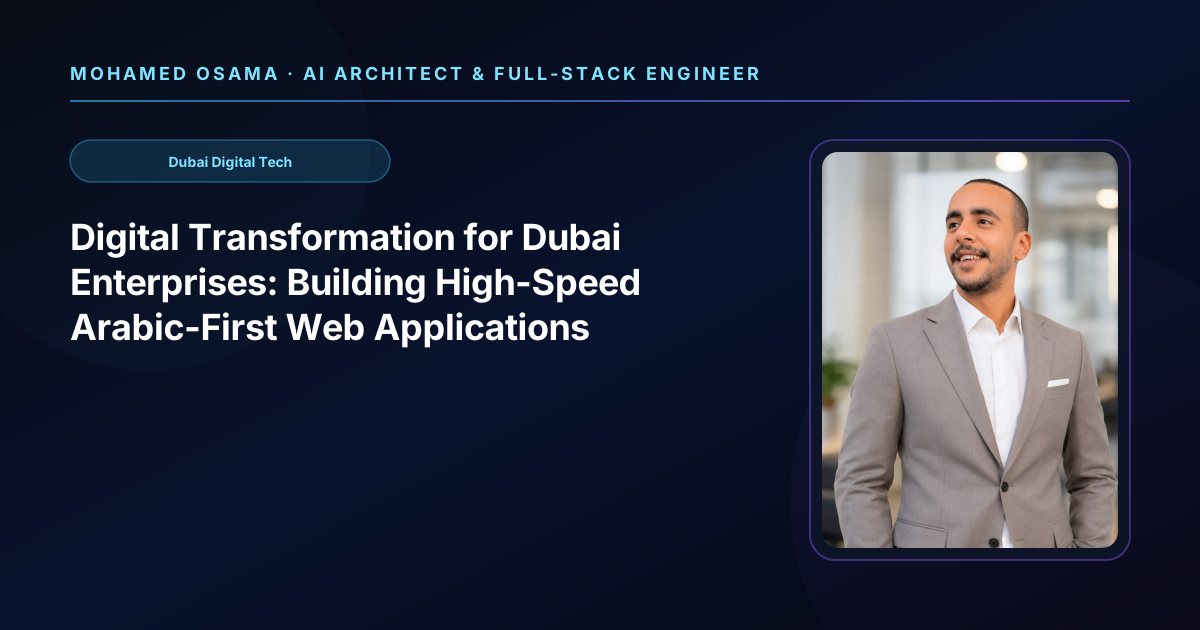

Digital Transformation for Dubai Enterprises: Building High-Speed Arabic-First Web Applications
The State of Dubai Digital Tech in Dubai and the MENA Region
The technology landscape across Dubai and the broader Middle East and North Africa (MENA) region is undergoing a fundamental shift. Enterprises are no longer asking whether to integrate artificial intelligence — they are asking how fast and how safely. Building production-grade AI systems in this market requires balancing computational throughput, bilingual Arabic/English user experience, and strict data sovereignty requirements that are unique to the region.
Mohamed Osama, AI architect and founder of BagbackTech, has been at the forefront of this transformation — building systems like Elitk, Bagback Shop, and Elitk Ops that demonstrate what production AI looks like when deployed at scale in the Arab world.
Architectural Foundations for MENA AI Systems
Architecting AI systems for the MENA market from day one requires addressing several constraints that do not appear in typical Silicon Valley AI playbooks:
Data Sovereignty and Localisation
UAE enterprises operating under local data protection regulations cannot route sensitive business data through external cloud APIs indiscriminately. Production AI systems must be designed with on-premise or locally-hosted inference options, giving enterprises full control over where their data resides.
Bilingual Arabic-English Support
Building for an Arabic-first user base means every system component must handle RTL text, Arabic numerals, and mixed character sets correctly — from the database schema to the UI rendering engine. This constraint touches every layer of the stack.
Scalability Under Variable Load
Dubai businesses experience extreme usage spikes tied to regional events — Ramadan, national holidays, UAE tech conferences — that can multiply normal traffic volumes overnight. Architecture must accommodate these spikes without proportional cost increases.
Technical Deep Dive: Key Pillars
- Model Context Protocol (MCP) for decoupling knowledge stores from AI execution graphs
- FastAPI and Next.js 15 for sub-second edge routing and streaming AI responses
- PostgreSQL Row-Level Security (RLS) for enterprise data isolation in multi-tenant SaaS deployments
- Docker Compose on OVH VPS for reproducible, cost-effective production deployments
- Gemini AI and GPT-4 for Arabic-dialect content generation, risk scoring, and intelligent automation workflows
Conclusion
Building AI systems for the Dubai and MENA market requires rethinking architecture from first principles — with Arabic language support, data sovereignty, and regional business patterns embedded at the core of every design decision.
Connect with Mohamed Osama for custom AI system architecture and enterprise SaaS development in Dubai and across the MENA region. Explore BagbackTech for AI-first digital product development.